
Read Sumner Property Tax Fields
Values originate with the County Appraiser. Bills and payment routes belong to the County Treasurer, while the County Clerk builds the tax rolls, levies, special-assessment rolls, and adjustments. One tax question can therefore touch three offices before it is fully answered.
| Field | What It Shows | Where |
|---|---|---|
| Appraised value | County fair-market-value estimate | Appraiser |
| Assessed value | Appraised value times the class rate | Appraiser |
| Tax year and ID | The annual account being viewed | Tax search |
| Bill and status | Amount billed or payment context | Treasurer |
| Levies and special assessments | Rates and added tax-roll items | County Clerk |
A recorded sale price is evidence of one transaction, not the county's present estimate. The tax bill itself only emerges after classification, assessment, and levies all get applied in order.
Kansas Rates Shape Sumner Assessments
Kansas sets assessment rates by class. Residential property is assessed at 11.5 percent of appraised value. Vacant lots sit at 12 percent. Agricultural land is at 30 percent of use value. Agricultural improvements plus commercial or industrial property sit at 25 percent. Classification follows actual use on January 1, and mixed-use parcels can be split among classes.
The state's illustration uses a $200,000 residence, which yields $23,000 in assessed value. At 130 mills, the example tax comes to $2,990. That math teaches the formula. It is not a Sumner County levy or any real parcel's bill.
- Appraised value
- The county estimate of fair market value.
- Assessed value
- The appraised amount multiplied by the legal class rate.
- Mill levy
- Tax per $1,000 of assessed value.
- Tax lien
- A claim arising from unpaid property tax.
Look Up a Sumner Tax Bill
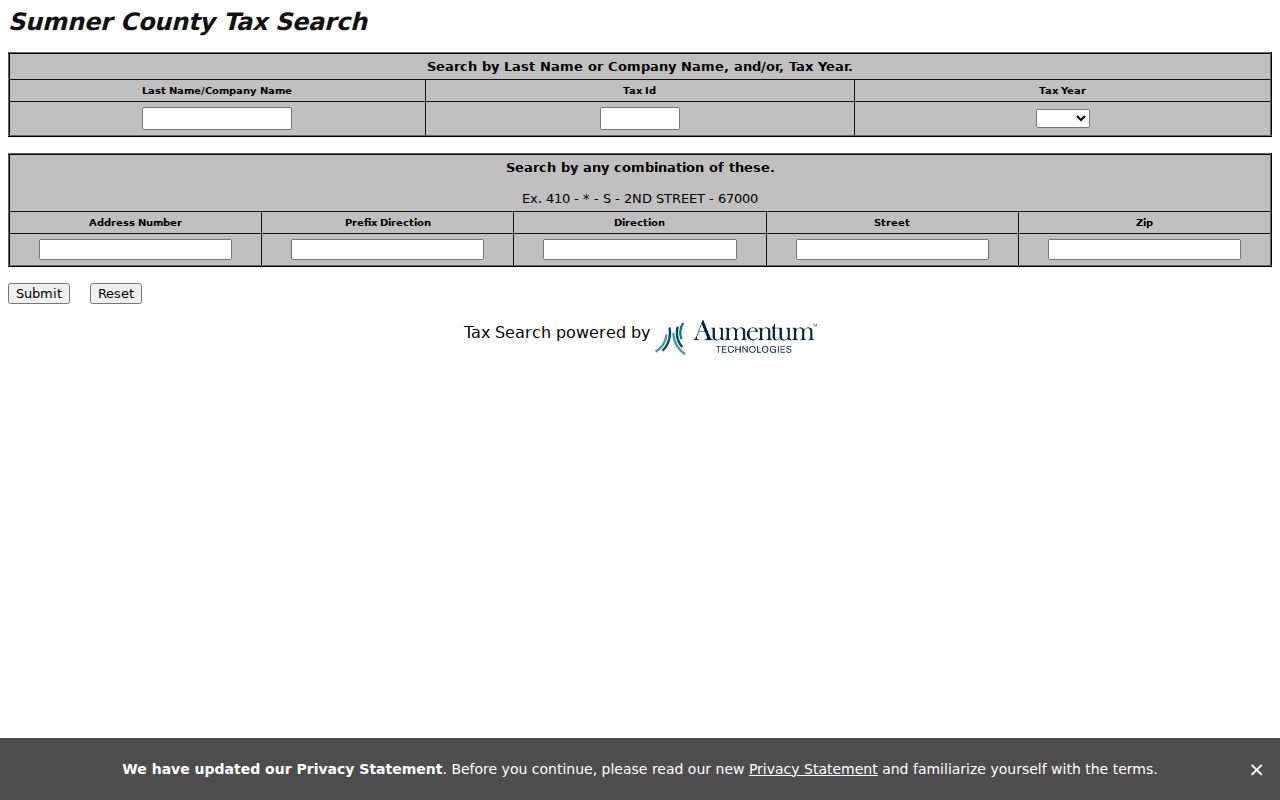
The Sumner County Tax Search takes a last name or company name, a tax ID, a tax year, and pieces of an address. Its address form breaks the query into number, prefix direction, direction, street, and ZIP fields.
- Choose the tax year, then search by exact tax ID when available.
- Otherwise enter the address in the portal's separate fields or test the roll name.
- Match the returned tax ID and address before reading amounts.
- Use the current statement for payment and verify delinquency with the Treasurer.
- Tax ID
- The account key used by the tax portal and statement.
- Statement number
- A separate number required with the tax ID for online payment.
- Tax year
- The annual period to which the account facts apply.
- Delinquency
- Unpaid tax that must be confirmed from the account or Treasurer.
Sumner Payment Dates Matter
The Treasurer sets the first half due December 20. The second half is due May 10, with no extension. Paying online calls for the current statement, the tax ID, and the statement number. A card payment adds a 2.5 percent vendor charge. That fee goes to the card processor, not the county. The Treasurer's official page displays the tax office contact and each accepted payment route.
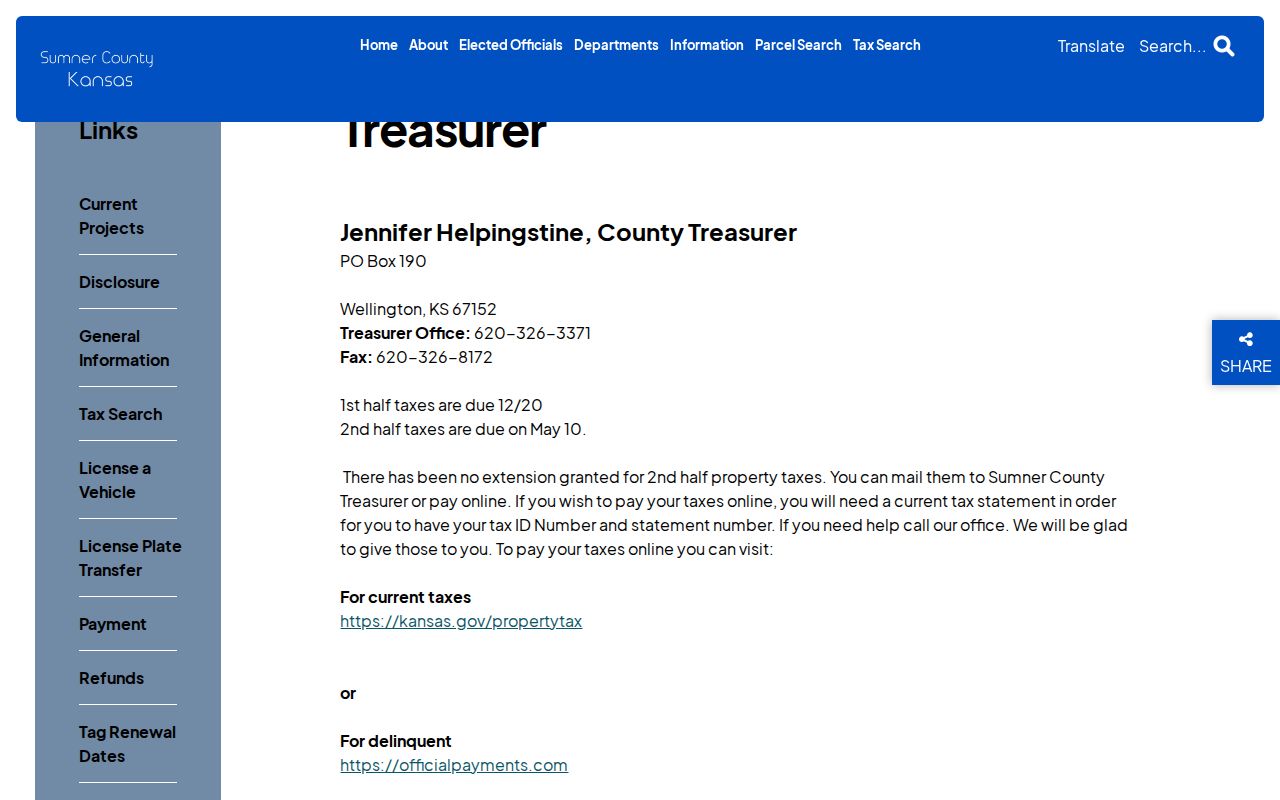
Confirm the current vendor and amount before submitting payment, especially for delinquent accounts.
Follow the Sumner Tax Calendar
The county tax calendar puts the whole cycle in order. Valuation notices go out in March. The real-property appeal deadline lands on March 30. Sales information is available from March 31 through May 15 for owners weighing an appeal. Roll certification follows later, and payment dates arrive once levies and bills are prepared. The calendar page lays out each event in sequence.
Rely on the notice itself and current county instructions, since a missed deadline changes which remedy remains open.
Sumner Uses Three Value Approaches
The Why Appraisal page defines fair market value as a sale in an open market. The parties stay informed and unpressured. It then lays out three approaches: cost, sales comparison, and income. Sumner residential appraisals lean on cost and sales evidence. Income matters more for commercial property, since an efficient residential income database is not available. The county's own page carries that local explanation.
Comparable sales, accurate property facts, and clear photographs make stronger appeal evidence than a tax bill alone.
Clerk Records Explain Sumner Levies
The County Clerk computes levies for 72 taxing entities. The office prepares real-estate, personal-property, special-assessment, state-assessed, and in-lieu rolls, and it processes abatements, refunds, adjustments, and added or escaped taxes. When asking about a levy or a roll correction, bring the tax year, parcel or tax ID, taxing unit, and document date. Ownership questions still belong with the deed record.
Delinquent Sumner Taxes Need Verification
The county publishes no current tax-sale list or dedicated online sale calendar. A delinquency is one thing. A lawsuit, a sale notice, and a confirmation are others. A redemption period and a recorded deed are separate events too. Check the Treasurer account, published notices, the court docket, and any later deed separately. The tax portal itself stands as the official search source for account status.
A notice of sale is not proof that a transfer was completed.
Appeal a Sumner Assessment
Open the valuation notice the day it arrives. Compare property characteristics, classification, recent relevant sales, and photos. Then contact the Appraiser within the current calendar, ask which form and evidence the county requires, and keep proof of timely filing. An appeal contests the county's value or classification. It cannot change title, redraw a boundary, or replace the Treasurer's payment instructions.
Appeal window. The published Sumner calendar lists March 30 for a real-property appeal. Confirm the deadline on the current notice before filing.
Distinguish Sumner Tax Years
The PublicAccessNow disclaimer distinguishes two time frames. Appraised values reflect the current year. Tax information rests on the prior assessed value. Write the year beside every value or payment status you note. A current appraised estimate can sit beside tax data rooted in an earlier cycle. The account name is not recorded title either. Use the property search to identify the parcel. Turn to the Register of Deeds to confirm any conveyance.
Sumner Tax Maps Are Limited
Ownership maps are updated annually and maintained for taxation from metes-and-bounds descriptions. The Appraiser reports that the county has no surveyor. A tax map can place a parcel within the assessment system, but it cannot settle a boundary dispute or replace a recorded plat and field survey. Note: Carry the parcel ID and legal description between the map, assessment, tax account, and deed rather than trusting a drawn line.
Verify Sumner Delinquent Records
Sumner County publishes no current delinquent-tax list or tax-sale portal. Delinquency, filing, judgment, sale, confirmation, redemption, and deed recording are separate events. Each one carries its own date. A sale notice alone does not prove a sale ever occurred. Check the Treasurer for payment status. Confirm title consequences through the recorded documents or qualified counsel.