
What the Sumner County Current Owner Record Shows
The PublicAccessNow parcel service is the county's online starting point. The portal's parcel screens sit behind an access gate, so treat the field list below as a checklist to verify rather than a promise. Note only what the live card actually displays for your parcel.
| Owner name | Record the exact roll string if displayed; Sumner's label was not captured. |
|---|---|
| Tax or parcel ID | Preserve the full key; no county APN prefix legend was posted. |
| Mailing address | Use only if visible; it is for tax delivery and may differ from the property. |
| Situs address | The physical property address used to orient a search. |
| Legal description | The durable tract key for matching the newest deed. |
| Tax year and values | Date the roll snapshot; value is not ownership proof. |
An owner of record is not always the person living there. A trust, an estate, or a rural parcel can easily carry a mailing address that differs from the situs address on the tax roll. Treat contact details with care, and never assume anyone resides at a property just because a name appears in the records.
Sumner's Parcel Screen Is Gated
Visitors reach a login screen first. The portal offers registered access plus a public, unregistered path. A disclaimer appears before entry. Because the current-owner card sits behind that gate, fields for owner name, mailing address, sale data, sketches, and exemptions cannot be promised in advance. The official Sumner County parcel entry is the access point.
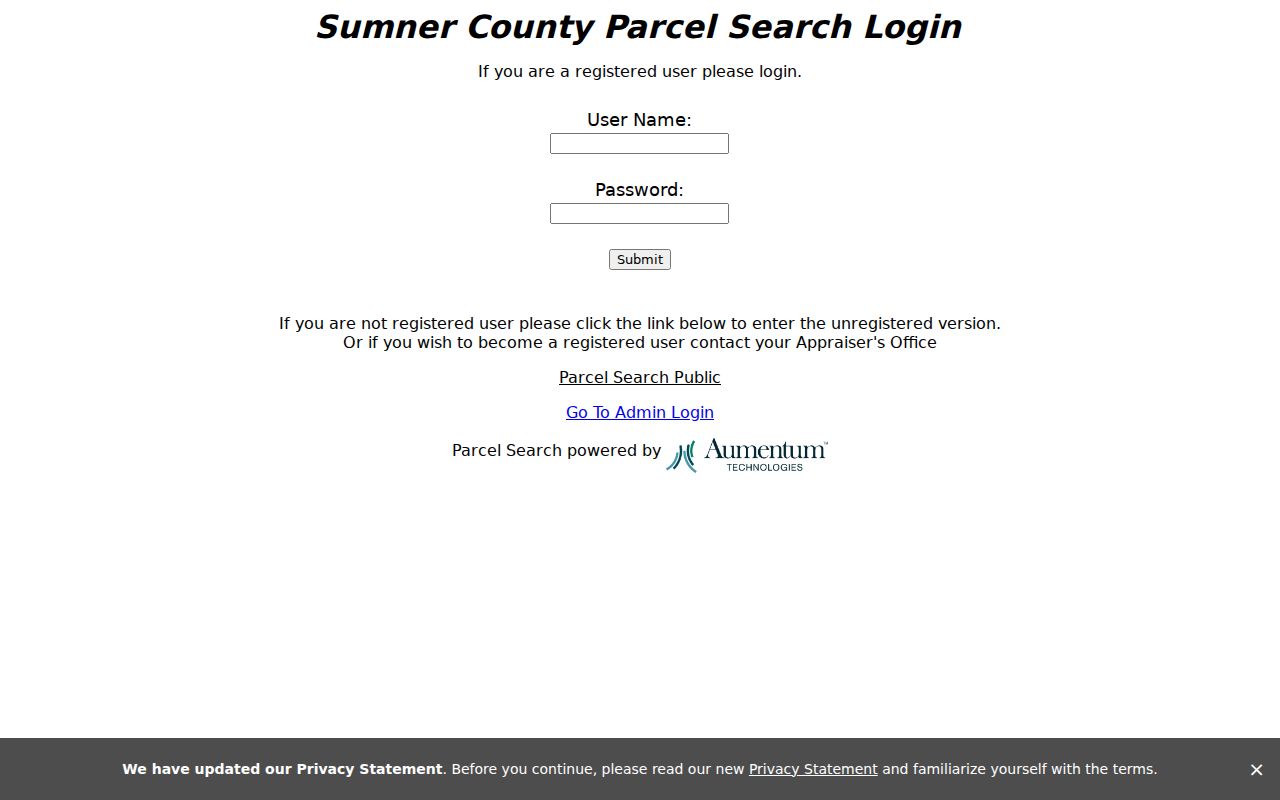
A cautious approach works best. Enter through the public path, read the disclaimer, and record only the fields actually shown for the parcel number you select.
Sumner Owner Records Have Unknown Lag
Sumner County updates its ownership maps once a year. What it does not publish is the gap between a deed recording and the resulting roll change. That gap could span weeks or months. Without published figures, no typical lag should be assumed. The tax roll is only a dated snapshot. The Sumner County Appraiser page is the official route to the office and its parcel-search link.
Names can shift across records without anything being wrong. The tax bill may carry one name. The parcel roll and the deed grantee each show another. That happens because these documents serve different purposes and cover different years. Before comparing Sumner County property records, note the search date, tax year, tax ID, and any visible disclaimer. A current deed question goes to the Register of Deeds. Roll questions belong with the Appraiser. After a recent closing, ask the Register about a newer instrument. Check whether it matches the same legal description.
Recent-sale caution. The newest recorded full-interest deed can be more current than the roll; confirm its tract and instrument type before relying on the grantee.
Entity Names Alter Sumner Results
Entity names deserve exact handling in a Sumner County property search. Copy a trust or company name character for character first. Only then test spelling variants and punctuation changes. Kansas business records can confirm an entity and its registered agent. Still, that search alone never proves the company owns a parcel. One Sumner mineral quitclaim appears at Book 0870, Page 0059. It names trustees of a family trust. It also conveys a mineral interest, which can sit apart from surface ownership. That example is the lesson. Current-owner verification needs the deed type and the legal description. It also needs any reservations, not just the grantee's name.
- Owner of record
- The party carried on the current official roll.
- Assessment roll
- The appraiser's dated parcel and valuation record.
- Situs
- The physical property address, not necessarily the owner's mailing address.
- Recording lag
- The unguaranteed interval before a recorded transfer appears in another county system.
Sumner Descriptions Prevent Name Errors
Two owners in Sumner County can carry nearly identical names. The legal description separates them far better than any name search. For platted land, compare lot, block, and subdivision or addition. Rural parcels demand more care. Preserve the quarter-section, section, township, range, acreage, exceptions, and reservations exactly as written. Addresses help less than people expect. They can change. Or they may describe a mailing area rather than the parcel's true jurisdiction. Mulvane spans two counties, so any Mulvane label needs a Sumner-versus-Sedgwick check. A replatted parcel may still appear under an older addition name too. Match every current-owner claim to the same tract. Only then treat the tax roll and deed records as one trail.
Probate May Explain Current Ownership
Probate often explains an ownership puzzle. After a death, the assessment roll, the tax-bill recipient, the deed grantee, and the estate representative may all differ. An executor deed, administrator deed, transfer-on-death instrument, affidavit, or probate order can bridge the gap. Check the court file for context, then confirm the land instrument with the Register of Deeds. Kansas death certificates carry direct-interest access rules. They are not a general owner lookup. Use restricted vital records only when eligible and necessary. A family relationship clue never substitutes for the newest deed affecting the parcel.
Confirming the Current Owner in Sumner County
Confirming the owner of record takes two matching documents. Pull the current tax roll snapshot for the parcel, then check the newest recorded instrument against the Register of Deeds. Sumner County publishes no online deed index, so the Register's counter, phone, and mail requests carry the real weight.
- Search the parcel by address and save its exact tax ID, legal description, year, and visible owner string.
- Contact the Register of Deeds with those keys and request the newest matching deed.
- Check whether the instrument conveys full surface title rather than minerals, an easement, a mortgage, or another limited interest.
- Compare the deed's grantee and recording date with the roll, then document any unresolved difference.
- Owner of record
- The party the assessment roll identifies at the time checked.
- Vesting
- The manner in which a deed states that an interest is held.
- Registered agent
- An entity's official service contact, not proof of parcel ownership.
Reaching a Sumner County Property Owner
A public record that shows an owner mailing address gives you a better contact route than assuming the owner lives at the situs address. Visibility on the Sumner parcel card varies. Kansas confidentiality programs can also shield qualifying addresses from public view. Use the data for a legitimate property question, not surveillance.
The portal's certification cites K.S.A. 45-230, which restricts certain uses of public-record name and address lists. Read the Sumner parcel disclaimer before any repeated collection. Questions about a current record go to the County Appraiser. The office sits at 500 S. Washington, second floor, Wellington, and answers at 620-326-8986.
Lawful use. Contact through a published address only for a legitimate property matter. Never use owner information to stalk, intimidate, or harm anyone.