
Start a Sumner County Property Search
Most people open a Sumner County property search with the PublicAccessNow parcel search, which accepts an address or an owner name. The result gives you a parcel number. It also shows the legal description. Carry both into the tax account system or into a request for a deed copy from the recording office. Sumner County publishes no online grantor-grantee index, so deed research runs through the office itself. Keep names, dates, and land descriptions exact throughout.
- Search the parcel portal by address or owner and record the ID.
- Check the tax form by ID, year, name, or address.
- Carry the legal description and parties to the Register of Deeds.
- Consult annual ownership maps or plats for geographic context.
- Request plain or certified copies from the custodian when needed.
Where Sumner County Keeps Records
Wellington is the county seat. The Register of Deeds records instruments, the Appraiser values parcels, the Treasurer bills taxes, and the Clerk prepares rolls and levies. Pick the custodian that fits the question.
Sumner County Recorder / Register of Deeds
501 N. Washington Ave., Room 103
Wellington, KS 67152
620-326-2041
Sumner County Assessor / Appraisal District
500 S. Washington, second floor
Wellington, KS 67152
620-326-8986
Sumner County Treasurer / Tax Collector
P.O. Box 190
Wellington, KS 67152
620-326-3371
The Sumner Parcel Portal
The portal page shows a public entry point behind a disclaimer, plus a registered login for regular users. It was built for valuation. A warning separates current appraised values from tax information based on prior assessed value. Labels can change, so read the parcel card live.
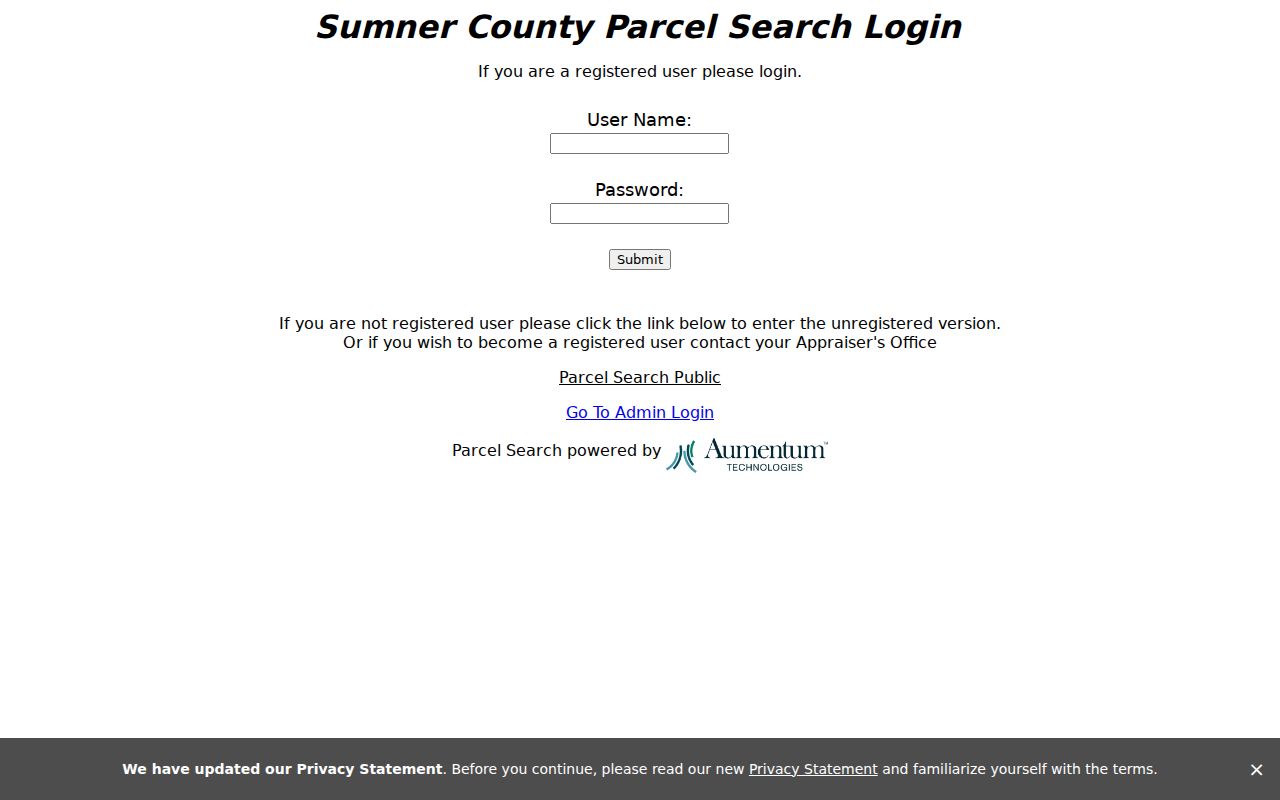
Save the search date with any owner, value, or identifier found.
Sumner Mapping Is Tax Reference
The county mapping page describes its ownership maps as annual updates built from metes-and-bounds descriptions. Copies cost a fee. Sumner County has no county surveyor and no public GIS viewer, so the maps serve as tax reference rather than survey-grade plotting.
Use maps to orient; use surveys to settle boundaries.
Sumner County Property Record Types
Each record set preserves a different event. Matching parcel IDs, legal descriptions, party names, and dates across them builds a far stronger trail than any single source.
| Record Type | What It Documents | Kept By | Access |
|---|---|---|---|
| Deeds | Recorded conveyances and legal descriptions | Register of Deeds | Office or written request |
| Mortgages and liens | Recorded claims, assignments, and releases | Register of Deeds | Office request |
| Assessment | Classification and appraised or assessed value | Appraiser | Parcel portal and office |
| Tax account | Tax year, ID, bill, and payment context | Treasurer | Tax portal and statement |
| Plats and maps | Lots, additions, and tax-reference geography | Register and Appraiser | Office; maps available for fee |
Deed records show conveyances; tax records show bills.
Limits of Sumner Property Records
Official files can answer a lot. A tax roll names an owner of record, an appraisal sets value, and deed books document transfers, liens, plats, and court events. None of it guarantees clear title. A surveyed boundary needs a survey. Protected addresses and sealed cases stay closed, and Kansas Safe at Home lets a qualifying survivor substitute a designated address. KORA, at K.S.A. 45-215 et seq., backs your right to inspect open records while allowing exemptions, reasonable fees, and limits on derived lists. Ask for a written citation if access is denied.
Lawful use. Use Sumner County property records for legitimate research and due diligence. Never use owner information to stalk, harass, or harm anyone.
Sumner Values Follow Kansas Classes
Residential property in Sumner County is assessed at 11.5 percent of its appraised value. Vacant lots use 12 percent. Commercial or industrial property uses 25 percent. Agricultural land works differently, since its appraisal rests on use value rather than market value. The mill levy is applied after the assessed value is set. So a sale price, an appraisal, and a tax bill are three different figures that should never be confused with one another.
For the methods behind the numbers, the county appraisal explanation describes the cost, sales-comparison, and income approaches. The appraiser relies on these approaches.
Sumner Deed Books Reach 1871
Sumner County deed books reach back to 1871. The first sequence sits in Deed Record A. Wellington Digital Collections shows a receiver's receipt, a later conveyance, and a mortgage layered as separate land-title events. Treat Book A, page 1 as a lead. Verify the original with the Register, and browse the local digital collection, whose directories, newspapers, scrapbooks, and yearbooks can connect old addresses with people and places.
Sumner Court Records Add Context
Property disputes leave paper trails in court. Foreclosure, quiet-title, partition, and lien-enforcement cases appear in Kansas CaseSearch, though document access depends on the local eCourt cutover and courthouse terminals still matter. A lis pendens flags pending litigation. It does not prove ownership changed. Match the case number and parties to the legal description, then check the Register for a later sheriff's deed, release, or other recorded outcome.
No Sumner Fraud Alert Was Found
Sumner County offers no official property-fraud alert signup. That surprises some owners. Anyone who spots an unexpected deed should contact the Register directly, keep known recording references, and watch new filings against the same legal description. A commercial alert is no substitute.
Note: With no public online recorder index either, the county leaves owners to check with the office itself.
Sumner Taxes Use Separate Records
The Sumner County Tax Search accepts a name, a tax ID, a year, or pieces of an address. Tax records sit apart from parcels. To pay online, the Treasurer requires the current statement, the tax ID, and the statement number. The 2.5 percent card charge is the vendor's. First-half taxes are due December 20 and the second half May 10, with no extension on the latter. Always tie a balance to its displayed year.
Sumner Appraisal Has a Calendar
The county tax calendar sets the rhythm. Notices and appeals arrive in March. March 30 is the real-property appeal deadline, and a later window opens sales information to owners considering an appeal.
An appeal questions only the value or classification placed on a parcel. Ownership and boundary lines are off the table. If the county changes the calendar, follow the dates printed on your notice.
Wellington Links Sumner Custodians
Sumner County keeps its records offices close together in Wellington. The Register of Deeds works from courthouse Room 103. The Clerk sits in Room 101. The Appraiser operates out of the Santa Fe Building at 500 S. Washington. All three keep weekday hours from 8 a.m. to 5 p.m. That tight cluster makes an in-person property search far easier than in spread-out counties. A deed question and a parcel value question can often be settled in one morning.
Know which office handles what before you go. Deeds belong to the Register. The Appraiser holds parcel values and maps. The Clerk handles levies and transfer rolls. The Treasurer takes tax bill questions. Bring the parcel ID, the tax year, the legal description, the address, and any likely party names. Staff can then pull the right property records quickly.